
Drawing Conclusions Examples
Drawing Conclusions Examples - Web remember the conclusion you're drawing must be supported by information in the text. Web examples of drawing conclusions: Flow charts guide the reader through a process; It helps to guide students to make meaning out of information that might otherwise be overwhelming. Intermediate readers benefit from answering questions and discussing what they have read. Instead, you have to put together some puzzle pieces to figure them. Web a conclusion is a judgement a reader makes based on facts and details from a text. Web drawing conclusions can be a particularly hard task for some readers. Full examples of research paper conclusions are shown in the tabs below: Web having carried out the research and marshalled all the evidence, you are now faced with the problem of making sense of it all. Your conclusion should give a sense of closure and completion to your argument, but also show what new questions or possibilities it has opened up. Web watch david work through a draw conclusions question from the praxis core reading test. Web knowing how to draw conclusions is an important skill requiring a reader to pay close attention to details in the text and draw on one's prior knowledge and experiences. We’ve created increasingly difficult worksheets for students to practice how to draw conclusions and make inferences in our reading comprehension section. As a writer, you are presenting your viewpoint, opinions, evidence, etc. And cause & effect diagrams. In this example, the facts we see are that the sky is cloudy, the ground is wet, and the umbrella is inverted. Story maps provide structure for summarizing a story; Web research paper conclusion examples. It helps to guide students to make meaning out of information that might otherwise be overwhelming. More than 1,500 ela activities. Story maps provide structure for summarizing a story; Web drawing conclusions is an essential skill for comprehending fiction and informational texts. Tie together the essay’s main points. In this example, the facts we see are that the sky is cloudy, the ground is wet, and the umbrella is inverted. We’ve created increasingly difficult worksheets for students to practice how to draw conclusions and make inferences in our reading comprehension section. Web a conclusion is a judgement a reader makes based on facts and details from a text. Web drawing conclusions can be a particularly hard task for some readers. Practice these strategies with the example below! In this example,. Web for example, venn diagrams are helpful when comparing two objects or ideas; Story maps provide structure for summarizing a story; We’ve created increasingly difficult worksheets for students to practice how to draw conclusions and make inferences in our reading comprehension section. Web watch david work through a draw conclusions question from the praxis core reading test. Instead, you have. Web this chapter provides guidance on interpreting the results of synthesis in order to communicate the conclusions of the review effectively. Web this is an example of how they draw their own conclusions from the text and synthesize their own directions and ideas. These are moments of synthesis. Show why your argument matters. Web a strong conclusion aims to: Instead, you have to put together some puzzle pieces to figure them. Here's a brief key describing most popular methods of inference, to help you whenever you're trying to draw a conclusion for yourself. Full examples of research paper conclusions are shown in the tabs below: Below, i break down how we can help our children develop this skill during. Tie together the essay’s main points. Web all of them have strengths and weaknesses that render them more useful in some situations than in others. Web examples of making inferences and drawing conclusions. Draw a conclusion together and then talk about what clues were used to come to that conclusion. Methods are presented for computing, presenting and interpreting relative and. Flow charts guide the reader through a process; Your conclusion should give a sense of closure and completion to your argument, but also show what new questions or possibilities it has opened up. Web sometimes, they imply, or suggest, a main idea through a series of specific statements that combine to suggest one general thought, leaving it to readers to. As a writer, you are presenting your viewpoint, opinions, evidence, etc. Web remember the conclusion you're drawing must be supported by information in the text. Web sometimes, they imply, or suggest, a main idea through a series of specific statements that combine to suggest one general thought, leaving it to readers to draw the appropriate conclusion based on the paragraph's. Remember, you are adding to the discourse community with every research paper that you write. Web a conclusion is a judgement a reader makes based on facts and details from a text. Web watch david work through a draw conclusions question from the praxis core reading test. Full examples of research paper conclusions are shown in the tabs below: And. Remember, you are adding to the discourse community with every research paper that you write. Web all of them have strengths and weaknesses that render them more useful in some situations than in others. Web this is an example of how they draw their own conclusions from the text and synthesize their own directions and ideas. Web knowing how to. Leave the reader with a strong impression. Tie together the essay’s main points. Web watch david work through a draw conclusions question from the praxis core reading test. More than 1,500 ela activities. Web drawing conclusions can be a particularly hard task for some readers. We’ve created increasingly difficult worksheets for students to practice how to draw conclusions and make inferences in our reading comprehension section. Web the key to drawing a valid conclusion is to ensure that the deductive and inductive processes are correctly used, and that all steps of the scientific method were followed. Web a strong conclusion aims to: Web all of them have strengths and weaknesses that render them more useful in some situations than in others. Your conclusion should give a sense of closure and completion to your argument, but also show what new questions or possibilities it has opened up. Remember, you are adding to the discourse community with every research paper that you write. Web remember the conclusion you're drawing must be supported by information in the text. For others to review, so you must take on this task with maturity, courage and thoughtfulness. These facts indicate that it’s rainy because the ground’s wet and because she has an. Flow charts guide the reader through a process; Web for example, venn diagrams are helpful when comparing two objects or ideas;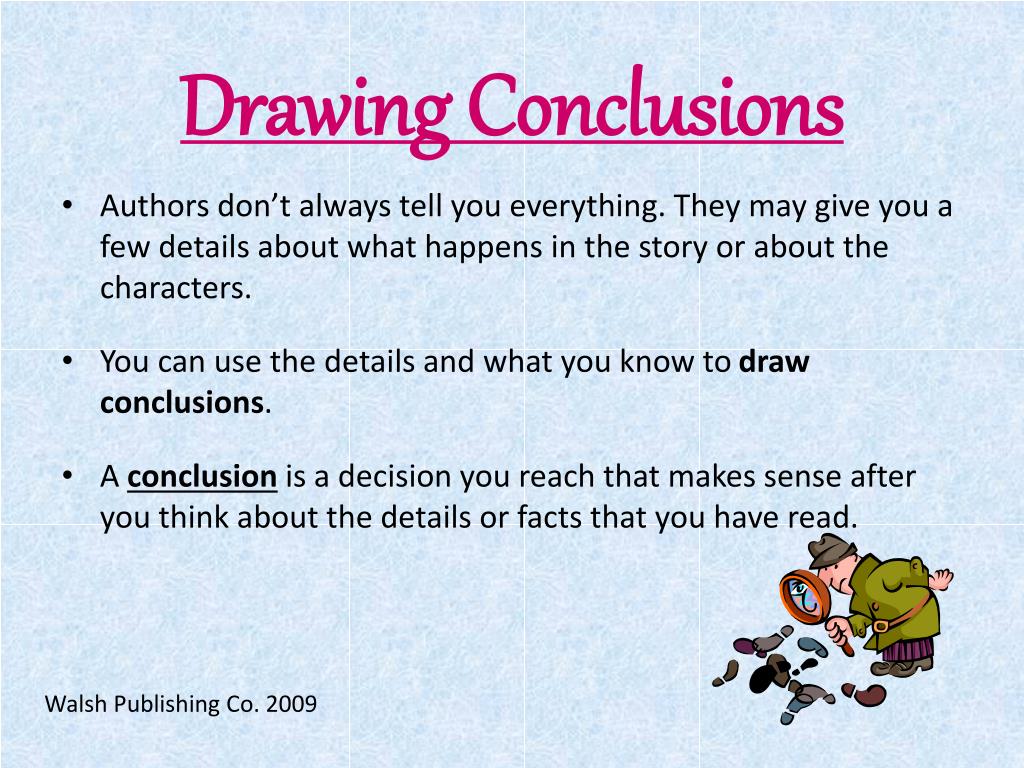
draw conclusion examples
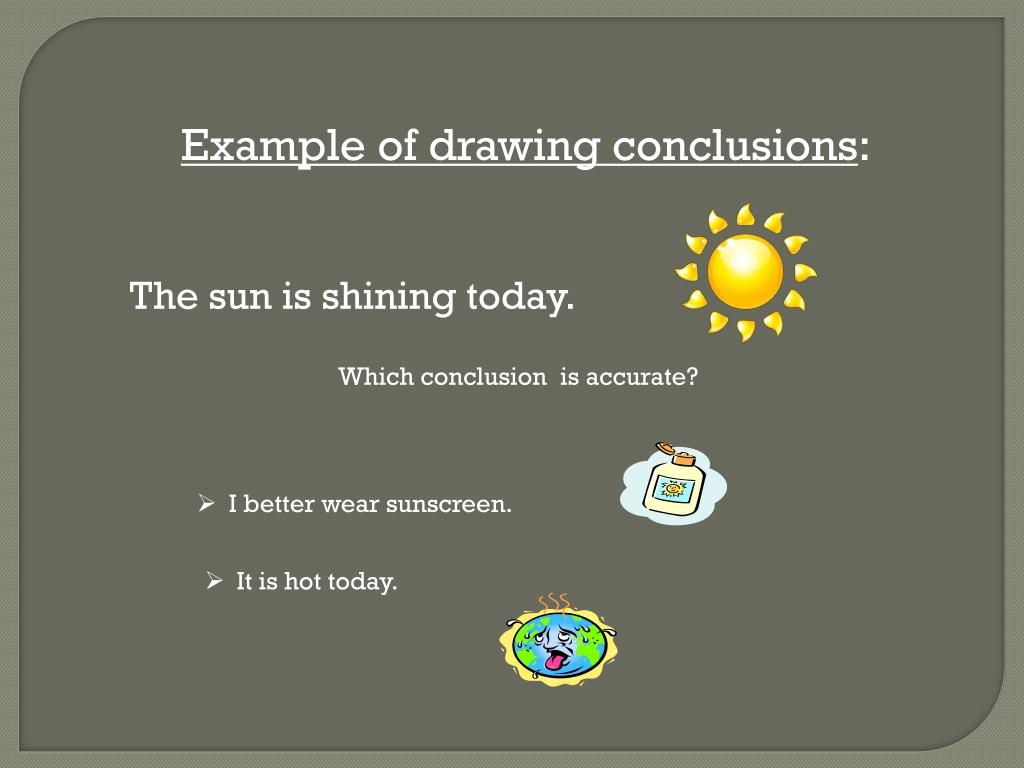
PPT Drawing conclusions PowerPoint Presentation, free download ID

Drawing conclusions anchor chart helpful to teach my bebes Reading

Drawing Conclusion Anchor Chart Drawing conclusions, Drawing

drawing conclusions examples with answers Writing Conclusion

Drawing conclusions anchor chart Artofit
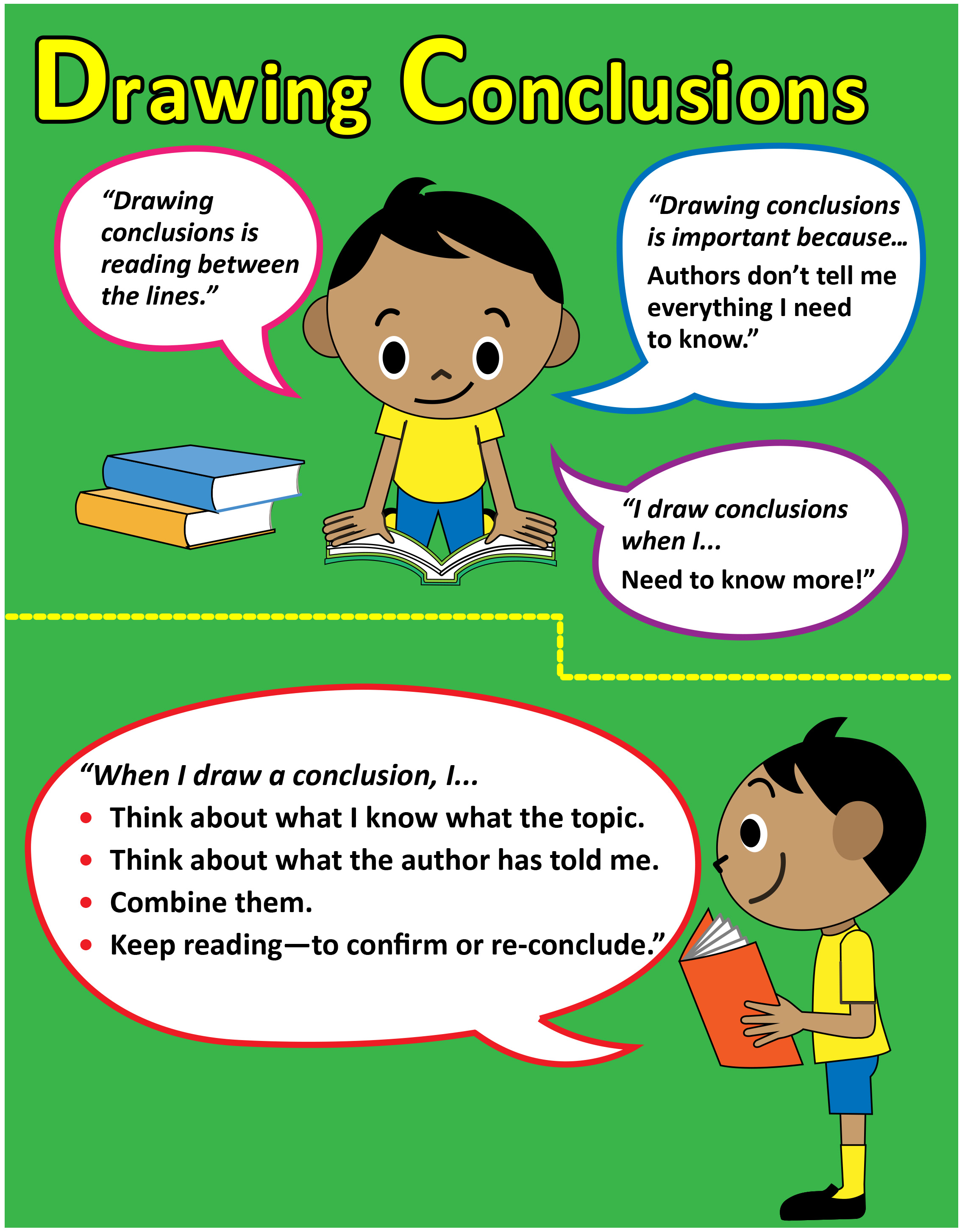
which conclusion can be drawn from this drawing

Drawing conclusions anchor chart I made. ) Drawing conclusions

Drawing Conclusions

drawing conclusions Drawing conclusions anchor chart, Drawing
As A Writer, You Are Presenting Your Viewpoint, Opinions, Evidence, Etc.
Web A Conclusion Is A Judgement A Reader Makes Based On Facts And Details From A Text.
Instead, You Have To Put Together Some Puzzle Pieces To Figure Them.
Web Having Carried Out The Research And Marshalled All The Evidence, You Are Now Faced With The Problem Of Making Sense Of It All.
Related Post: